From Firelight to Server Rooms
complete
Topic
I'll be driving for about an hour and a half or so. If you can entertain me with some stuff like the start of humans in prehistory, computer sysadmin type information, etc (which I'll let the etc do a lot of work there) I'll appreciate it.
Audio
Generated Text
Let’s begin very far back, not at the beginning, because beginnings are usually places we choose for convenience, but at a point where the world has already been going on for a long time without anything like a person to notice it.

Imagine a landscape in eastern Africa, though not with the clean outline of a modern map. No countries, no names, no borders, no airports, no road signs with distances to towns. Just ground, heat, weather, water moving downhill, animals carrying their own private reasons through the brush. The ancestors of humans are there, but they do not know they are ancestors. They are not waiting to become us. They are simply creatures with bodies that need food, shade, company, sleep, and ways not to be eaten.

There is something slightly strange about looking at prehistory from our side of the glass. We tend to search it for the first signs of ourselves. The first tool. The first fire. The first burial. The first bit of pigment on a shell. The first footprint that looks like someone was walking with purpose. But at the time, none of those things had the grand meaning we give them. A flake of stone was not “technology” in the abstract. It was an edge. An edge is a very powerful thing if you have fingers, hunger, and a world made of skins, stems, bones, hides, and fibers. An edge lets a soft animal negotiate with a hard world.

If you imagine a hand holding a sharpened stone, it is easy to picture invention as a sudden moment. Some hairy genius gazing at a rock and realizing, with a spark of proto-scientific insight, that it can be broken in a useful way. But probably it was more like a long conversation between hands and materials. Stones break. Sometimes they break badly, sometimes they break beautifully. A creature notices, not necessarily in words, that a broken stone can slice. Another stone can make this happen. A certain movement of wrist and arm works better than another. The knowledge does not have to live in a sentence. It can live in muscles, in imitation, in the way an older one sits near a younger one and does a thing again and again.

That is one of the oddities of being human: so much of what we are begins as repeated action before it becomes explanation. A person learning to use a command line is not entirely different. At first, the terminal is a dark rectangle where spells must be typed exactly. You enter `ls`, and the machine reveals the local contents of its small invisible room. You enter `cd`, and you relocate not your body, but your attention. You learn that a slash is not just punctuation but geography. You learn that the computer has places inside it, and some places are ordinary, and some are sacred, and some are full of things you should not remove unless you understand what kind of afternoon you are asking for.

It is tempting to make sysadmin work sound grand: the keeper of systems, the guardian of uptime, the quiet figure who maintains the invisible plumbing of civilization. And to be fair, there is some truth in that. But much of it is also very humble. It is looking at logs. It is asking, “What changed?” It is remembering that a filesystem can fill up, that certificates expire, that clocks drift, that humans write passwords on sticky notes, that backups that have not been restored are not yet fully backups, only hopeful artifacts.

In that sense, system administration is not so far from the ancient maintenance of a camp. Someone must know where the water is. Someone must notice whether the fire is low. Someone must remember that the group used to cross the stream downstream, but lately the bank has collapsed. Someone must understand the patterns of trouble. The old human world had no servers, but it had dependencies. It had provisioning problems. It had latency, in the form of distance and weather. It had security issues, in the form of leopards, rival groups, spoiled food, and children wandering toward hazards with the focused incompetence common to young mammals.

I like thinking about the first humans, or nearly-humans, as administrators of fragile little systems. A band of people is a system with moving parts. It has inputs: food, water, fuel, information, births. It has outputs: waste, tools, stories, decisions, footprints, smoke. It has resource constraints. It has social protocols. It has failure modes. If the group is too large, it may exhaust local food. If too small, it may be vulnerable. If trust breaks down, coordination suffers. If the old knowledge is not transmitted, the system loses resilience.

And all of this existed before writing, before charts, before anyone could file an incident report.

What is strange is that we often talk about “primitive” life as though it were simple. But simplicity is often just what complexity looks like when we do not understand its categories. A hunter-gatherer may not have known the capital of France, but also had no reason to. They might know, instead, the mood of a landscape across seasons. Which roots are safe if processed one way but dangerous another. Which animal tracks are old because their edges have softened. Where bees may have nested. Which relative is angry, which visitor is unreliable, which child is getting strong enough to carry something useful. This is not a smaller mind. It is a mind trained on a different database.

And databases themselves are a funny human invention: organized memory outside the body. A clay tablet with grain accounts is already a database, though it smells of dust rather than ozone. A knotted cord can be a database. Notches on bone can be a database, maybe. A story can be a database if it reliably stores instructions inside narrative. “Do not go to that place in winter,” becomes a tale about a spirit there. The tale persists because it has teeth. It bites the imagination.

Computers have made memory seem abstract, but it remains physical. Somewhere, charges are held, magnetic orientations are adjusted, tiny floating gates trap electrons like microscopic jars with lids. Even the cloud is earthly. It is buildings. It is power cables, cooling units, diesel backup generators, chain-link fences, contracts, shifts of tired technicians, and blinking lights in rooms where no one lives. The cloud is just someone else’s cave wall, maintained at industrial scale.

Prehistoric humans also had clouds, in a way, though theirs were made of other minds. If one person knew how to make a certain tool, that knowledge was highly available as long as the person remained alive and socially accessible. But it had no redundancy unless others learned it. A death could be data loss. A migration could be data fragmentation. A taboo could be access control. An initiation could be credentialing. A song could be compression, a way to pack a map into rhythm and recall.

The more you think about it, the more culture resembles a long-running system with no single administrator. It is patched constantly, often badly. It carries legacy features no one fully understands. It has strange permissions. There are rituals equivalent to scripts that are executed because they have always been executed. Some of them perform real work. Some once performed real work but now mostly consume resources. Some prevent disasters in ways that are not obvious until someone disables them.

This is true in offices, too. A person arrives and asks why the deployment process includes a manual step where someone named Karen checks a spreadsheet. Everyone shrugs. It has always been there. Then Karen retires, the spreadsheet is missed, and three weeks later some downstream system receives malformed data and begins emailing invoices to a test address last used in 2017. It turns out Karen was a load-bearing mammal.

I sometimes wonder how much of early human culture was load-bearing in that way. An outsider might see a ritual before a hunt and think it irrational, and perhaps some parts were. But maybe it gathered people at the right time, synchronized attention, calmed fear, reinforced roles, checked equipment, and made sure no one was missing. The chant may have been the user interface for a procedural checklist. The spirits may have been the branding layer on operational discipline.

This does not mean everything has a hidden practical function. Humans are too excessive for that. We decorate. We exaggerate. We make things meaningful beyond their utility. Someone long ago shaped a hand axe so symmetrically that modern observers suspect it was not only a tool but also a display, almost a stone peacock tail. “Look,” it may have said, without language or with language, “at how well I understand stone, patience, force, and form.” Even now, we do this. A clean server rack, beautifully cabled, is not just efficient. It communicates moral seriousness. The cables fall in blue and yellow bundles like disciplined vines. The labels are legible. The airflow is respected. One looks upon it and thinks: here, perhaps, chaos has been temporarily negotiated with.

That temporary quality is important. Nothing stays fixed. Prehistory is sometimes imagined as a vast static period, because the artifacts change slowly compared with phones and operating systems. But from inside a life, everything would have been changing. Children became adults. Elders died. Rains failed. Animals moved. A useful tree fell. A river changed course. A neighboring group appeared at the horizon. New stone sources were found. Old paths became unsafe. Someone tried a new way to bind a point to a shaft. Someone else objected.

The slowness is ours, imposed from far away. We see ten thousand years as a unit because our evidence is sparse. But nobody lives in ten thousand years. They live in mornings.

There is a beautiful and slightly eerie fact about deep human time: for most of our existence, there were no cities, no agriculture, no written laws, no metal, no wheels, no empires, no money in the usual sense. Anatomically modern humans appear roughly three hundred thousand years ago, give or take depending on definitions and discoveries. Agriculture begins maybe twelve thousand years ago in several places, again with caveats. That means the human animal spent the great majority of its time in small groups, moving through landscapes, making decisions in conversation with weather, animals, plants, and each other.

Civilization, as we usually mean it, is recent. It is not fake, and it is not superficial exactly, but it is recent, like a complicated application running on old hardware. The hardware was shaped by conditions that no longer resemble a supermarket, a calendar app, or a quarterly tax deadline. We carry old systems inside us. We are primates using cryptography. We are savanna-adapted social animals arguing with printers.

Printers deserve their own small archaeological layer. If future beings dig through our remains, they may find printer cartridges and conclude we worshiped small expensive boxes that refused offerings unless the cyan cartridge was present. The printer is a humbling device because it reveals the fragility of the idea that digital information has conquered matter. A document lives happily as bits until a human requests that it become a flat physical object. Then rollers, powders, drivers, permissions, network discovery, firmware, paper humidity, and obscure resentment enter the story.

Sysadmins know that the physical never goes away. A loose cable can masquerade as a software problem. A server can overheat because someone stacked cardboard too near a vent. A data center can suffer because of a squirrel, a backhoe, a flood, or a person who unplugs the wrong thing in a moment of sincere concentration. The world keeps inserting itself into the abstraction.

Prehistory is also a reminder that intelligence is embodied. Human cleverness is not a glowing orb inside the skull. It includes hands, shoulders, gait, digestion, eyes, sweat, childbirth, childhood, and the ability to throw. Throwing is extraordinary. Other animals can fling things, but humans became accurate, forceful throwers. Our shoulders are peculiar devices. A thrown stone, or later a spear, extends the body’s influence across distance. It is a remote procedure call performed with muscle.

Walking, too, is technology in the broad biological sense. Bipedalism freed hands, but it also made humans into persistent movers across open landscapes. We are not the fastest animal in a sprint, but we are oddly good at continuing. A human walking is an animal falling forward and catching itself, again and again, with great confidence. The arms swing as counterweights. The head rides atop the spine like a careful sensor platform. The eyes scan. The feet read the ground by pressure.

There is something server-like about the body during a long walk or drive: background processes continue. Breathing, temperature regulation, digestion, memory consolidation, the quiet scanning for threat or opportunity. Consciousness gets a small dashboard, but most of the system is not exposed to the user. You do not manually instruct your pancreas. You do not allocate memory for recognizing a familiar face. You do not type a command to heal a cut. The body is full of daemons.

And like daemons, they can fail silently until they cannot. Much of medicine is log analysis performed on flesh. A symptom is an error message, often badly worded. “Pain near here.” “Tired.” “Dizzy sometimes.” The clinician asks what changed, checks histories, runs tests, considers dependencies. The human body has legacy code older than fish, patched through reptile, mammal, primate, and hominin versions, all still somehow shipping to production.

This is one of the pleasures of thinking across scales: the same patterns appear with different costumes. Maintenance, memory, error, adaptation, cooperation, signal and noise. A prehistoric campfire and a server monitoring dashboard are not the same thing, of course, but they rhyme. Both gather attention around a point of concern. Both ask: is the system still alive? Is heat where heat should be? Is something consuming too much? Is there danger in the dark beyond the visible circle?

Fire itself may be the great sysadmin of human evolution. Or perhaps that is giving it too neat a title. But once humans could reliably use fire, many things changed. Food became softer, safer, more digestible. Nights became socially different. Predators were held at a distance. Cold places became more negotiable. The fire was a tool, a place, a process, and an obligation. It had to be fed. It had states: lively, low, embers, dead. It required fuel management. It produced waste and risk. It could protect the group or destroy the camp.

It is hard to imagine the first controlled fire without accidentally imagining a campfire from modern leisure: people seated pleasantly, perhaps with mugs. But early fire would have been a serious companion. Smoke in hair, sparks on skin, children warned away, embers preserved. Fire is not owned so much as hosted. It is a guest that eats constantly and must be watched.

Computers, too, are hosted processes that eat constantly. Electricity goes in, heat comes out, and in between, some arrangement of symbols is maintained against entropy. That is almost everything, if said broadly enough. Life itself: energy in, waste heat out, structure briefly maintained. The universe seems not to mind disorder, and yet here and there, little pockets of order arise by feeding on gradients. A bacterium does this. A forest does this. A city does this. A laptop does this, though less poetically when its fan begins whining during a video call.

If we return to early humans for a moment, one of the most consequential developments was probably not a single invention but an increasing capacity for shared attention. To look where another looks. To understand that another creature knows something you do not. To teach intentionally. To deceive. To joke. To imagine the unseen. Language, whenever it emerged in its richer forms, must have transformed the human world. Not because grunts became Shakespeare in one leap, but because language lets minds network.

A spoken sentence is a temporary bridge between nervous systems. One person has seen water over the ridge; another has not. The first makes patterned air with the mouth. The second’s ears receive vibrations, the brain reconstructs meaning, and now the unseen water affects behavior. This is almost absurd when looked at from a distance. Air pressure variations alter the future.

Networking in computers feels more technical, but it is also a miracle of agreement. Machines that cannot know one another agree on protocols. They chop messages into packets, wrap them with addressing information, send them through cables, fibers, radios, routers, switches, and hope. TCP is a kind of politeness ritual: did you receive this? Yes. Here is the next part. If not, I will say it again. UDP, by contrast, is more like shouting birds into the wind: here it is, do what you can.

Human communication contains both. Some speech is TCP: careful, acknowledged, corrected. “Meet me by the large tree at sunset.” “This tree?” “No, the one near the stream.” Some speech is UDP: laughter, alarm cries, gossip released into the social atmosphere, fragments of song. And some is broadcast storm, as anyone who has been trapped in a group argument can confirm.

What makes humans especially dangerous and interesting is not just that we communicate, but that we accumulate. One clever animal can invent a thing. A culture can keep it, modify it, and combine it with other things after the inventor dies. This is cumulative culture, and it is a kind of version control, though without commit messages for most of history. A tool changes shape across generations. A boat design improves. A recipe becomes safer. A myth absorbs a migration memory. A language shifts, forks, merges, deprecates sounds, imports vocabulary, and occasionally crashes into another language and leaves both altered.

Writing made the commits more durable. Suddenly, words could outlive the breath that formed them. They could travel without the speaker. They could be audited, copied, mistranslated, canonized, burned, hidden, rediscovered. Writing is an external memory device with social consequences so large that we are still inside its shockwave. Laws become stable enough to be oppressive at scale. Accounts become exact enough to support taxation. Poetry becomes portable. Lies become documentable. Bureaucracy blooms like mold on stored grain.

Agriculture and settlement changed the human system architecture. Instead of small mobile groups with relatively low material accumulation, humans began clustering around fields, herds, irrigation, storage. Stored grain is a quiet revolution. It permits surplus, but surplus attracts attention. It can feed specialists, rulers, priests, soldiers, scribes, rats, and thieves. Once you have storage, you have inventory. Once you have inventory, you have accounting. Once you have accounting, you have someone asking why the numbers do not match.

The sysadmin version of this is familiar. A small system can run on informal memory. One person knows the server. The password is in someone’s head. The deployment is manual but manageable. Then the organization grows. Suddenly there are environments, access roles, compliance requirements, monitoring, backups, onboarding, offboarding, secrets management, incident response, change control. Complexity enters not because anyone desired ceremony for its own sake, but because scale produces new failure modes.

Cities were like that. Useful, powerful, dense, and full of new ways to fail. Disease loved cities. So did trade. So did ideas. So did hierarchy. The city is a machine made of humans, buildings, rules, animals, refuse, water, and desire. It lets strangers cooperate without becoming kin. That is an astonishing trick. In a small band, you know people directly. In a city, you rely on roles, signs, prices, uniforms, reputations, documents, architecture. You buy bread from someone whose grandmother you have never met. You trust bridges built by the dead. You drink water routed through systems you cannot personally inspect.

Modern computing extends this trust into invisible realms. You press a glass rectangle, and somewhere, perhaps thousands of miles away, a machine checks whether you are allowed to see a photograph, move money, unlock a door, or summon a car. The ritual is so ordinary that it no longer feels like sorcery. But it is worth occasionally estranging it. A person taps a symbol. The symbol wakes a radio. The radio converses with towers. Packets travel through buried fibers and bright rooms. Databases consult tables of permission. A response returns, and the person is admitted, denied, charged, entertained, or tracked.

From afar, humans appear to have surrounded themselves with responsive surfaces. Doors open if we carry the right token. Vehicles speak in icons. Refrigerators beep with moral urgency. Watches comment on our pulse. Houses listen for names we gave to cylinders on countertops. We built an environment that asks us to authenticate ourselves constantly, as though the tribe has become very large and no one quite recognizes anyone anymore.

Authentication is ancient, though. “Are you one of us?” may be among the oldest social questions. The answer could be face, smell, voice, scar, accent, kinship, shared memory, ornament, ritual phrase. Modern passwords are simply a thin, annoying descendant of this deep concern. A password is a little secret handshake with a machine that has no hands and no judgment except comparison.

And like all authentication, it is vulnerable to deception, forgetfulness, coercion, and laziness. Ancient humans may have imitated calls, worn symbols falsely, told persuasive lies. Modern humans reuse passwords, click links, misconfigure buckets, and grant permissions at 4:57 p.m. because a task must be finished and the warning dialog has the personality of a nagging insect.

A great deal of security is the study of human impatience. This is not an insult. Impatience is part of being a time-bound creature with many needs. If the secure path is too hard, organisms seek a shorter path. A locked gate beside a trampled gap in the fence is a complete essay on security design. The same applies to software. If a process requires twelve approvals for a harmless change, people will invent unofficial channels. Shadow IT is just the desire path through the digital grass.

Prehistoric landscapes had desire paths too: tracks worn by repeated feet, hooves, paws. A path is memory pressed into ground. It says: many bodies found this route acceptable. It does not guarantee safety, but it offers inherited preference. In computing, defaults are paths. People follow them because they are there. This gives defaults enormous moral and practical weight. A default open port, a default password, a default privacy setting—these shape behavior more powerfully than policy documents.

Maybe one of the hidden continuities from prehistory to now is that humans are not purely rational agents but path-following, tool-using, socially alert animals. We do not approach each situation as a fresh mathematical problem. We ask what others are doing, what worked last time, what is near, what is easy, what feels safe, what the interface suggests, what the group will tolerate. This is why design matters. This is why culture matters. This is why the shape of a doorway can influence whether people gather or pass through quickly.

There is an old dream that technology will free us from maintenance. It never does. It changes the maintenance. Agriculture did not eliminate foraging labor; it introduced weeding, irrigation, storage, property disputes, and taxation. Writing did not eliminate memory; it introduced archives, copying, interpretation, forgery, and lost passwords in the form of forgotten scripts. Computers did not eliminate paperwork; they made paperwork capable of reproducing at light speed.

The human story, seen one way, is a sequence of clever solutions that create interesting new obligations.

Fire cooks food and must be tended.

Stone tools cut and must be made.

Language coordinates and can deceive.

Agriculture feeds more people and binds them to fields.

Cities enable specialization and require sanitation.

Servers centralize services and require backups, patches, monitoring, access control, and someone willing to wake up when alerts arrive.

There is something tender about this, if one is in the mood to see it that way. Humans keep making arrangements that are too complicated to leave alone, and then appointing some among themselves to notice when they begin to fail. The person who tends the fire at night, the person who cleans the irrigation channel, the monk copying a manuscript, the clerk maintaining ledgers, the engineer replacing a failed disk in a RAID array—all are participating in the same broad gesture: preserving a pattern against loss.

And loss is always nearby. Not always dramatically. Sometimes it is quiet. Bit rot. A forgotten language. A toolmaking technique no one practices. A family recipe altered because one ingredient vanished from the region. A photograph stored on a device whose charger is missing. A server image no one can rebuild. A cave painting sealed by a rockfall, waiting in darkness for eyes not yet born.

The deep past is full of darkness of that kind. Most human moments left no trace. The laughter, arguments, bad weather, flirtations, small repairs, private griefs, ordinary meals—gone. Archaeology works from what endured: stone, bone, charcoal, pollen, teeth, shells, DNA if fortune allows. It is like reconstructing an entire data center from a handful of surviving screws and a partial log file. One must be careful. One must imagine, but not too confidently.

Still, the fragments are enough to show that we come from beings who were already intensely themselves. They cared for children. They learned landscapes. They made things. They likely mourned. They adapted. They noticed patterns. They lived in bodies under the sky, which is still what we do, even when the sky is hidden by ceiling tiles and notification banners.

Maybe this is a good place, somewhere in the middle of the drive, to picture a small camp at dusk. Not as a sentimental paradise, because it was not that. There is hunger sometimes, injury, parasites, fear, conflict, infant mortality, cold. But also not as a brutish waiting room before history. It is history, just mostly unrecorded. Smoke rises. Someone cracks a bone for marrow. Someone shapes a stone edge with careful blows. A child watches, then looks away, then watches again. Someone returns with news: tracks, weather, strangers, fruit. The group adjusts. The fire is fed. The night comes close but not all the way in.

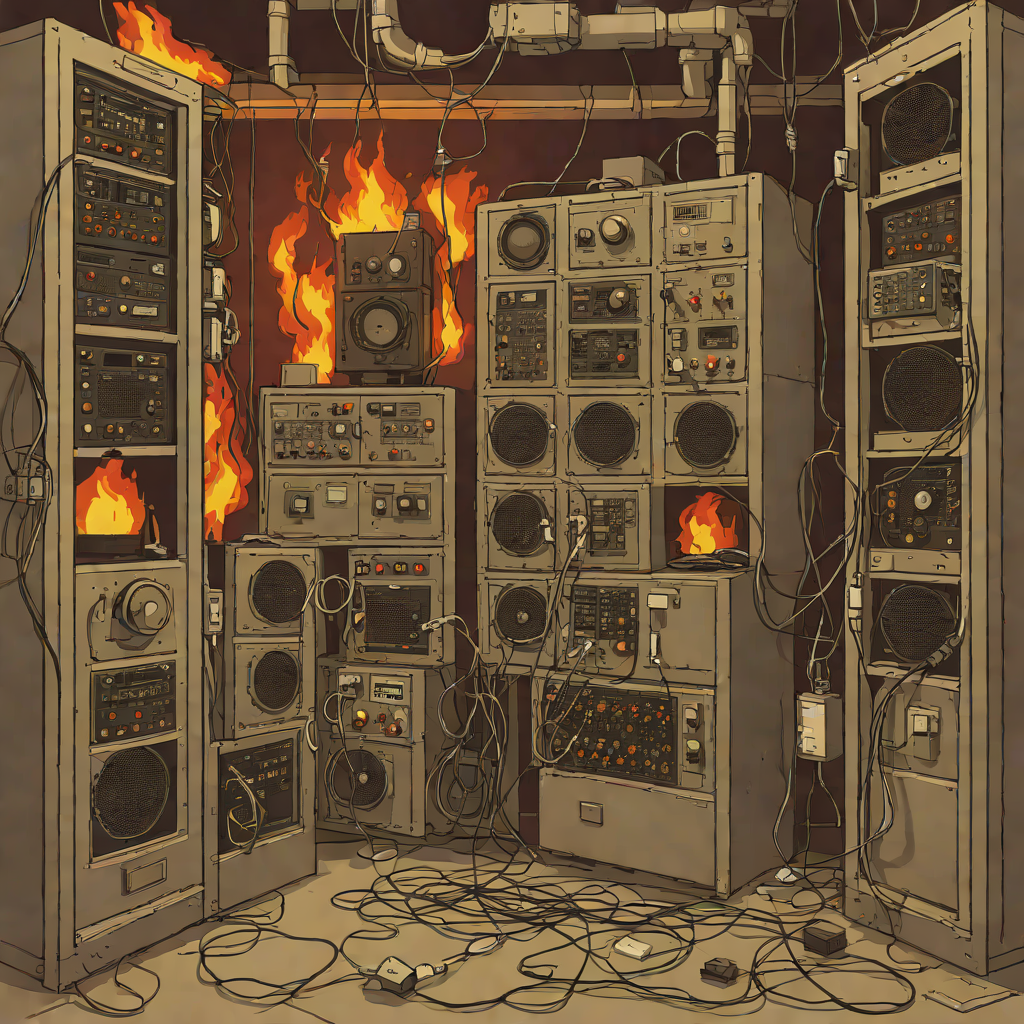
Now shift, without entirely leaving that scene, to a server room at night. The air is cold and mechanically disciplined. Machines are stacked in racks, each with small lights blinking in patterns that seem meaningful even when they are merely activity indicators. Cables run in bundles. Somewhere, fans maintain the correct thermal conditions for thought-like operations performed in silicon. A person stands there with a laptop, checking logs, replacing a drive, tracing a cable, listening to the sound of equipment the way a mechanic listens to an engine or a parent listens to a sleeping child.

Both scenes are about continuity. Keep the fire alive. Keep the service alive. Keep the group alive. Keep the information from disappearing. Keep the danger at the edge of the circle.

Of course, the server room is stranger. The people who depend on it may never see it. Its work is abstracted into conveniences. Messages delivered. Payments processed. Maps loaded. Names resolved. In DNS, there is even something wonderfully ancient: the translation of names into locations. A human says a name; the system finds where that name lives. Before DNS, there were elders, guides, traders, memory-keepers. “Where is the place with good stone?” “Who are the people beyond the ridge?” “Which path leads to water?” Names and routes have always been bound together.

DNS failure, for all its technical specificity, has a mythic quality. The thing exists, but its name no longer leads you there. It is as if a village has vanished from the map while still physically standing. Many outages feel like failures of naming, trust, or memory rather than matter. The server is up, but the certificate expired. The service is running, but the token is invalid. The data exists, but permissions deny it. The path is present, but no one has access. In human terms: the food is in the storehouse, but the key is lost; the elder knows the song, but no one asked; the bridge stands, but the sign says closed.

It may be that “etc,” in your topic, does a lot of work because these things are not as separate as they first appear. Prehistory, computers, administration, roads, bodies, fires, passwords, memory—they all belong to the long story of a peculiar primate making arrangements with the world. We inherit more than inventions. We inherit habits of attention. We inherit the tendency to gather around problems, to name things, to make tools, to patch systems, to complain about the patch, to teach the young, to mistrust strangers and then become dependent on them, to make symbols and then live inside them.

If one were truly studying Earth from afar, one might describe humans as medium-sized cooperative apes with unusually elaborate external memory systems. They began by modifying stones and landscapes, then plants and animals, then rivers, metals, laws, electromagnetic signals, and genomes. They are never satisfied with the given interface. If a mountain is in the way, they make a pass, tunnel, myth, or border. If night is dark, they make fire, lamp, grid, screen. If memory fades, they make song, inscription, book, database. If distance separates, they make paths, wheels, ships, cables, satellites.

And yet after all this, a human still needs rest. Still becomes irritated by a small noise. Still finds comfort in warm food. Still looks at a horizon with ancient equipment: eyes, vestibular system, predictive brain, mammalian heart. Still listens to a voice while traveling, allowing another mind’s patterned air, or its digital descendant, to occupy the cabin for a while.

There is a modest wonder in that. You are moving along a road, probably at a speed that would have terrified most of your ancestors, inside a machine powered by refined ancient sunlight, guided by signs and lanes and laws and perhaps satellites. Around you are systems layered upon systems: fuel distribution, traffic engineering, weather forecasting, manufacturing, insurance, emergency services, software, maintenance schedules, asphalt chemistry. And inside the vehicle is an old human activity: someone telling you things to pass the time as the landscape changes.

The ancestors would recognize that part, at least. The travel, the voice, the weaving of useful facts with idle speculation. The way one thought suggests another. The way a journey becomes a container for memory.

And somewhere in the background, servers are working. Some machine may have delivered these words. Some process accepted a request, routed it, generated text, returned it, stored logs. Electricity flowed. Heat was produced. Cooling systems carried it away. Protocols did their rituals. Names resolved. Packets arrived. The whole invisible village cooperated so that, for a while, a voice could accompany a traveler.

That is not a bad use of a few million years of toolmaking.