Walnuts in West Concord
complete
Topic
The life of a squirrel in west concord, ma who (along with a bunch of other squirrels) gets walnuts a few times a day from someone’s driveway.
Audio
Generated Text
There is a particular kind of morning in West Concord when the air seems to arrive before the light does.

It comes down the street softly, carrying the smell of damp leaves, old stone walls, and the faint metal coolness of the railroad tracks. The houses are still quiet. A porch light here and there holds a small circle against the gray. Somewhere, not too far away, a crow makes one low remark and then thinks better of saying more.

And in the branches of a maple near a driveway, a squirrel is already awake.

He has no name, at least not in the way we mean names. Among squirrels, recognition is more a matter of motion, scent, posture, and memory. A twitch of a tail. A scar along one ear. A certain boldness at the edge of a branch. This particular squirrel is gray, though not evenly gray. His back has the mixed salt-and-pepper pattern of a creature who has spent his whole life blending into bark, stone, shadow, and November weather. His belly is pale. His tail is considerable. His eyes are glossy and dark, reflecting everything and explaining nothing.

If we were to name him for our convenience, we might call him Maple, because he spends so much time in that tree, and because his days are shaped by its limbs the way our days are shaped by rooms.

Maple lives in West Concord, Massachusetts, in the loose, overlapping way squirrels live anywhere. His territory is not a property line. It is a network. A sugar maple beside a driveway. A white pine behind the garage. A fence top that leads to another fence top. A stone wall with gaps where acorns roll and insects sometimes shelter. A roofline, if necessary. A quiet corner of the yard where the hostas fold and unfold with the seasons. A pair of oaks down the street, which matter very much in autumn. The world, for Maple, is not a map seen from above. It is a series of passages remembered by the body.

He knows which branch bends but does not break. He knows which wire can be crossed when the air is dry. He knows where the neighborhood dog can reach and where it only believes it can reach. He knows the time of day when the blue jays are most argumentative, and the time when the humans who walk with coffee are likely to pass under the tree without looking up.

Most importantly, he knows the driveway.

It is not a grand driveway. It belongs to an ordinary house on an ordinary street, which is to say it belongs to one of the most interesting places in the world if one is willing to look slowly. The driveway has a slight slope, enough that rainwater gathers briefly along one edge before slipping toward the road. There are small cracks where grass tries its luck. In autumn, maple seeds collect there in little brown crescents. In winter, the surface holds tire marks in slush. In summer, it warms under the sun and gives off a faint mineral smell after rain.

And several times a day, walnuts appear there.

Not by magic, though to the squirrels the distinction may be unimportant. A person comes out of the house carrying them. Sometimes the walnuts are in a bowl. Sometimes in a hand. Sometimes there are many. Sometimes only a modest scattering. The person may pause, look around, toss a few toward the edge of the drive, perhaps set some near the base of the tree. Then the door closes again, and the quiet resumes, except now the quiet contains walnuts.

This changes the neighborhood.

Not entirely. The sun still rises over Concord in its mild and practiced way. The Assabet River still moves through town, sometimes shining, sometimes brown and full after rain. The commuter rail still makes its regular interruptions, a hum and a clatter and then the fading sound of people being carried elsewhere. Children still go to school. Leaves still fall. Snow still softens the shapes of things. But for the squirrels, the walnut driveway is a point of gravity.

Maple is not the only one who knows this.

There is a smaller squirrel with a narrow face and restless movements, a squirrel who appears to be made of questions. There is an older female with a torn edge to one ear, calm in the way of animals who have survived many winters and do not waste motion. There is a dark gray squirrel with almost black fur along the spine, who prefers to wait under the hedge until the first rush is over. There are two young ones, late-summer squirrels, still not fully polished by experience, who chase each other in spirals around the maple trunk and sometimes forget why they came.

At walnut time, the driveway becomes a small public square.

The first arrival is usually not the bravest squirrel but the most attentive one. Often this is Maple. He has learned the sounds that precede the offering: the dull shift of a door latch, the footstep on the threshold, the brief pause before the screen door breathes shut. Sometimes he is wrong. Sometimes it is only a person taking out trash, or collecting a package, or standing on the step to look at the sky. In those cases he freezes, tail arched, pretending that he had no expectations at all.

But when the walnuts come, he descends.

A squirrel coming down a tree is a small marvel, though we grow used to it. Headfirst, claws finding bark, tail balancing and correcting, he flows downward as if gravity were a familiar acquaintance rather than a law. At the base he pauses. This pause matters. It is the border between vertical safety and open ground. His nose works quickly. His whiskers tremble. The driveway lies ahead, plain and exposed, but also full of possibility.

Then he runs.

Not in a straight line, exactly. Squirrels rarely trust straight lines. He darts, stops, darts again, making a little zigzag of caution and appetite. A walnut half lies near the tire track. Another squirrel has seen it too. For one breath they arrive together, neither fully committed to conflict. Tails flick. Bodies angle. There is a tiny standoff with no ceremony. Maple lunges, seizes the walnut, and bounds away, not far, just far enough to sit upright near the maple root and turn the prize in his paws.

The paws are worth noticing.

They are very small hands, though not hands in the human sense. Long-fingered, alert, able to rotate and steady and test. Maple holds the walnut the way someone might hold a warm cup on a cold porch, with concentration and familiarity. His incisors find an edge. There is a dry ticking sound as he works. He does not eat as if dining. He eats as if solving. A walnut presents a series of practical questions: where is it thinnest, where does it yield, how much can be taken now, is it worth carrying away?

The person in the house may see him through a window. Or may not. There is something gentle about feeding an animal that will never truly be yours. A dog, even a reserved dog, eventually joins the household story. A cat may negotiate terms but still becomes part of the furniture of a life. A squirrel remains outside the glass. Even if it comes daily, even if it learns the timing and grows bold enough to sit in plain sight, it keeps its wild seam intact.

This is perhaps part of the pleasure.

To give walnuts to squirrels is to participate in a small exchange without closing it into ownership. The walnut is offered. The squirrel comes, or does not. There is gratitude only if we are generous in our interpretations. The squirrel is not thankful in the way a person writes a note. It is attentive. It remembers. It adjusts its day around the fact of the offering. Maybe that is a kind of thankfulness older than language: the body returning to a place where life was made easier.

West Concord is a good place for such arrangements. It has, like many New England towns, a layered quality. Human life is very present—houses, sidewalks, trains, bicycles, school buses, cafés, crosswalk buttons, trash barrels waiting at the curb—but the older life of the land presses through everywhere. Stone walls run between yards, their rocks lifted from fields by people long gone. Oaks lean over streets. Chipmunks flicker in and out of shrubs. Turkeys appear with the seriousness of visiting officials. Rabbits browse at dusk. Deer pass silently through places where no one expects an animal that large to fit.

And squirrels, of course, are everywhere, though each one inhabits the town differently.

Maple’s West Concord is mostly above knee height and below roof height. It is bark, gutter, branch, fence, eave, leaf litter, and the undersides of things. He knows the town by its climbable surfaces. A human walking down the street may notice a renovated porch or a changing garden bed, but Maple notices the removal of a low branch, the arrival of a new bird feeder, the sudden absence of a rotted stump that had been a useful launching point. Human improvements can be squirrel inconveniences. Squirrel improvements are usually accidents.

The walnut driveway is not an accident, though it may have begun casually. Perhaps one day the person noticed a squirrel near the garage, small paws tucked against its chest, and thought: here, have this. Perhaps there were extra walnuts from baking. Perhaps the habit started in winter, when everything looked tight and frozen and a squirrel on snow seemed especially earnest. It is easy for a single gesture to become a ritual if both sides return to it.

And both sides did.

By midmorning, if the weather is fair, the squirrels begin to assemble before the door opens. Not in a neat group, not like birds on a wire, but as scattered possibilities. One on the stone wall. One flattened along a branch. One behind the mailbox post. Maple waits halfway up the maple, high enough to feel safe, low enough to see. His tail rests over his back like a question mark.

Inside the house, ordinary things are happening. A cup is rinsed. A sleeve is pulled on. A message is read. A bowl is lifted. From Maple’s point of view, humans are puzzling, inconsistent creatures, but not entirely unreadable. They move loudly. They reveal their intentions with objects. When a human carries a rake, leaves shift. When a human carries a hose, water comes. When this human carries the walnut bowl, the world improves.

The door opens.

There is that half-second in which everything holds still. The person steps out. The squirrels, even the bold ones, retreat slightly. This is not distrust, exactly. It is respect for size. A human is a weather system with legs. Even a kind human is enormous. The walnuts scatter over the driveway with small, hard sounds, and then the person goes back inside.

The rush begins.

It might seem, from a distance, like chaos. Gray forms dart from every direction. Tails flare. Leaves jump. A walnut rolls and is intercepted. One squirrel grabs a piece too large and drags it sideways, stopping every few inches as if surprised by its own ambition. The young squirrels chase not only the walnuts but each other’s excitement. Someone makes a sharp chattering noise from the fence. The older female gets what she came for without appearing to hurry.

Maple is practiced. He knows that the closest walnut is not always the best walnut. The nearest pieces attract competition. A slightly farther one, half hidden by a leaf, may be safer. He moves toward it with deliberate indirection, as though merely passing through. Then, in one clean motion, he takes it and withdraws.

Not every walnut is eaten at once.

This is one of the great squirrel themes: the difference between now and later. Squirrels are famous for burying nuts, and like many famous facts, this one is both true and more interesting than its simple version. A squirrel does not merely store food in one pantry. It scatters its savings across the landscape, hundreds or thousands of small caches, each one pressed into soil or leaf litter and concealed with quick pats of the paws. Some will be found again. Some will be stolen. Some will be forgotten and perhaps become trees, though a walnut in a driveway neighborhood has a more complicated future than an acorn in a forest.

Maple carries one walnut toward the side yard. He passes under the hydrangea, stops near a patch of loose soil, digs quickly, places the nut, covers it, and then performs a little act of disguise, arranging the surface with his nose and paws. He looks around. Another squirrel is watching from the fence.

This is a problem.

So Maple digs the walnut up again and carries it elsewhere.

It is easy to smile at this, but there is a deep intelligence in the behavior. The world, for a squirrel, is full of watchers. Blue jays watch. Other squirrels watch. Crows watch with an unnerving patience. Even humans watch, though humans are less likely to steal buried walnuts. To cache food is not simply to hide it from winter. It is to hide it from a community of interested witnesses.

Maple tries again near the base of a pine, under needles. This feels better. He presses the walnut into the earth, covers it, and pauses with one paw lifted. The body seems to ask: will I remember? The answer is not a sentence. It is scent, location, geometry, the angle of the pine root, the feel of the soil, the relation of this place to the maple and the driveway and the bright square of the garage door.

Then he leaves it.

There is a kind of faith in leaving a walnut underground.

Not the grand kind. Nothing that would look good carved into stone. Just the small practical faith of a creature who cannot keep everything in sight and still live. Maple cannot sit all day on his buried treasures. He cannot defend every cache. He must trust some combination of memory, luck, and abundance. He must trust that a world with enough hiding places is survivable.

The day moves on.

By noon, the light has shifted. The driveway is brighter now, and the neighborhood has fully awakened. Cars pass. Someone wheels a bin back from the curb. A dog in a red harness pauses at the foot of the maple and inhales a whole novel of squirrel information. Maple observes from a high branch, body flattened, tail hanging down along the bark. The dog looks up. The squirrel looks down. Between them stretches an old relationship made mostly of impossibility.

The person may come out again.

Another scattering of walnuts.

This time Maple is not first. The narrow-faced squirrel reaches the drive before him and makes off with a large half. The older female takes two trips, efficient and untroubled. One of the young squirrels becomes so excited that it drops its walnut, chases another squirrel, remembers the dropped walnut, and returns to find it gone. It sits for a second on the asphalt, front paws empty, as if absorbing the lesson.

Maple finds a piece near the walkway. He eats this one where he sits.

While he eats, the town continues around him. The train sounds in the distance, approaching West Concord station. It is a long, low note at first, then the rhythmic crossing noise, then the heavy rush of metal and windows. Humans on the platform may be looking at phones, holding bags, thinking about work or home or the next thing. The train gathers them up and moves on toward Acton in one direction, toward Concord and Boston in the other.

Maple does not care about Boston.

This is not ignorance. It is scale. His world is full enough. A squirrel does not need a distant city to have complexity. Under one maple there are rivalries, seasonal changes, food economies, danger, pleasure, weather, memory, and the daily interpretation of signs. A squirrel’s life is not small to the squirrel. It is only small when viewed from the wrong distance.

In the afternoon, Maple rests.

Squirrels are often described as frantic, and certainly they can appear that way. Their movements are quick, abrupt, elastic. But much of their life is also stillness. Maple settles in a fork of the maple where three branches meet and cradle him. His tail curls along his side. The bark is cool. Above him, leaves shift and show their undersides in the breeze.

Rest, for a wild animal, is rarely complete abandonment. One ear remains available. One eye may open at a sound. The body lowers its flame but does not extinguish it. Still, there is ease here. The stomach has food in it. Several walnuts are hidden. The day is not too cold. The hawk that sometimes circles above the neighborhood is not presently visible.

A red-tailed hawk does pass through this part of town from time to time. Its presence changes the air. The squirrels know, and the birds know, and even if a human notices only a broad-winged shape gliding over the houses, the smaller lives below have already revised their plans. Maple has a particular way of vanishing against the trunk when the hawk is near. He presses himself flat, becomes bark-colored, becomes not worth noticing. His heart moves rapidly, but the rest of him is stone.

Today, though, there is only the breeze.

And perhaps this is the right moment to think about walnuts themselves.

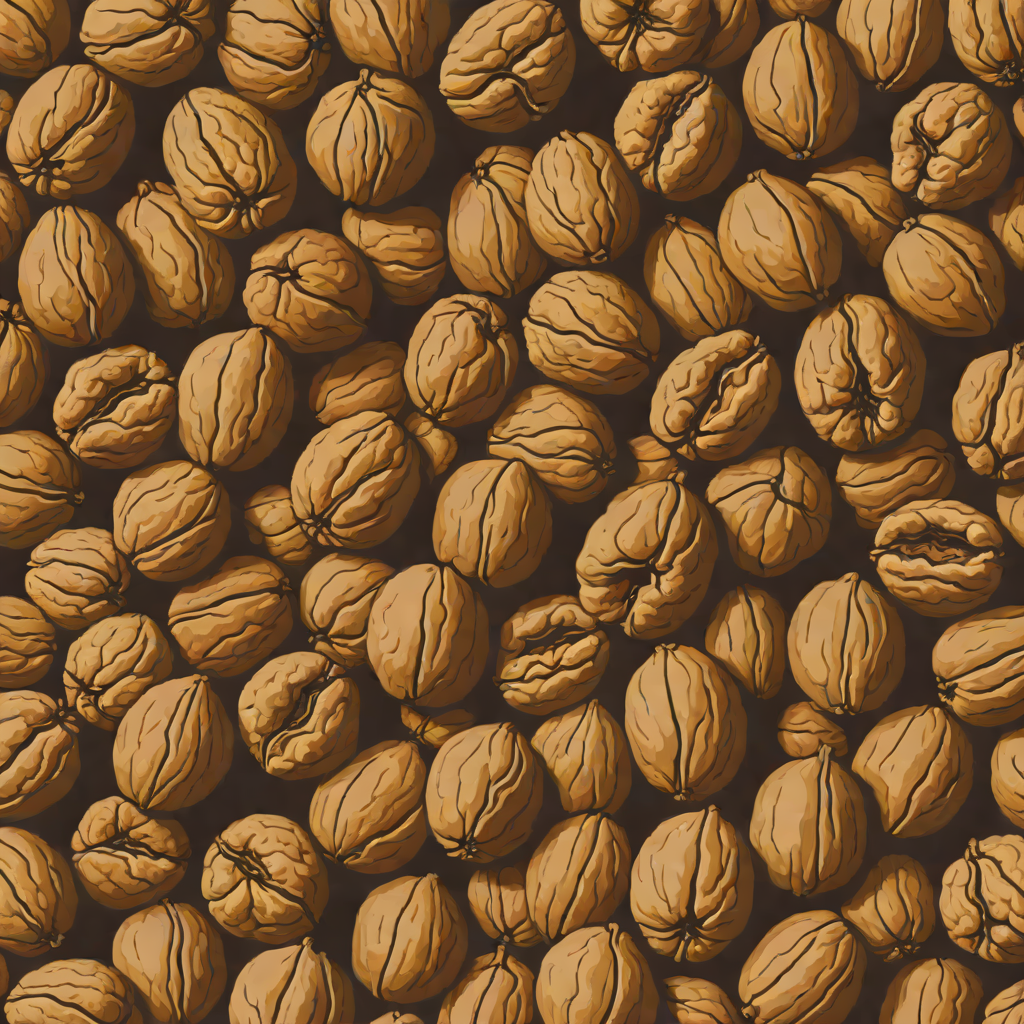
A walnut is a dense object, wrinkled and rich, an edible brain inside a hard shell. To humans, walnuts belong to bowls on tables, banana bread, salads, holiday baking, the backs of pantries. To squirrels, they are wealth. Fat, protein, calories that can be carried in the mouth. A walnut is concentrated autumn. Even when given in spring or summer, it has the feeling of stored time.

There is something pleasing about the fit between walnut and squirrel. The nut demands effort. The squirrel is built for effort. Teeth that grow continuously, paws that manipulate, jaws that test and pry. An animal’s body is a record of its long negotiations with the world. Maple’s teeth are not merely teeth. They are tools shaped by generations of shells, bark, seeds, and necessity.

By late afternoon, the light lengthens. Shadows from the houses stretch across lawns. The driveway cools. A child’s bicycle clicks past. Somewhere someone is cooking onions, and the smell drifts lightly down the street before thinning into the general smell of evening.

The squirrels become active again.

This is a busy hour. There are natural foods to check, hidden stores to revisit, final chances before dark. The walnut driveway may produce one more offering. Maple positions himself early. So does everyone else. The young squirrels are learning the geography of waiting. One selects a branch too thin and must adjust awkwardly. Another descends too soon and startles at a passing car, racing back up the tree with undignified speed. The older female sits on the stone wall as if she has seen many generations of fools and expects to see many more.

The door opens.

Walnuts.

This time they are tossed a little farther, perhaps to distribute the crowd. A few land near the side of the driveway. One bounces into the grass. One rolls under a parked car. That one becomes the subject of great interest and some confusion.

Maple takes a large piece and heads not to the maple but across the lawn, then along the fence, then to the back corner where the ground dips slightly. This is farther than usual. He may have a cache there. Or perhaps he is choosing a new place because the familiar ones are too well observed. He stops beside a tuft of grass, digs, places, covers, pats.

The evening deepens around him.

If it is autumn, the urgency is stronger. The air carries the edge of what is coming. New England autumn has a beauty that is also a warning. The maples flame and the oaks bronze, and humans drive slowly along roads admiring the color, while squirrels read the same color as a timetable. Leaves falling mean cover, but also the approach of bare branches. Frost sharpens scent. Days shorten. Food must be found, buried, remembered, defended, found again under snow.

In winter, the walnut driveway becomes more than pleasant. It becomes significant.

Imagine Maple in January. The maple tree bare, the sky pale, snow banked along the driveway in uneven walls. The person opens the door, breath visible, and places walnuts on a shoveled patch. The sound of them landing is softer now. Squirrels arrive from white branches, their bodies rounder in winter coats, their tails puffed. They leave delicate tracks, pairs of small prints like punctuation marks across the snow.

A walnut on snow is visible from far away. Too visible, perhaps. Maple takes his and retreats to the tree. He eats with flakes clinging to his whiskers. The world is reduced in winter: fewer smells, fewer insects, fewer easy finds. But the hidden caches under the snow are still there, and the driveway still gives.

There is an old question hidden in feeding wild animals: whether we should.

The answer is not always simple. Feeding can create dependence, crowding, risk, and imbalance. Bread for ducks, for instance, is famously unhelpful. Feeding bears is dangerous for everyone, especially bears. But a few walnuts for neighborhood squirrels occupy a gentler, smaller category. Still, even here, there are questions. Does it change their routes? Yes. Does it bring them together more often than they might otherwise gather? Yes. Does it make the driveway part of their mental landscape? Certainly.

But urban and suburban animals already live in relation to us. They eat from our oak trees, raid our bird feeders, nest in our eaves, cross our roads, learn our schedules, suffer our carelessness, benefit from our plantings, adapt to our fences. The boundary between wild and human-made is not a clean line in West Concord. It is more like a woven edge. A walnut offered by hand is one strand among many.

What matters, perhaps, is the spirit and the scale of the offering. Not possession. Not taming. Not the demand for performance. Just the quiet placement of food, and then stepping back.

Maple will never become a pet. If the person steps too close, he flees. If a hand reaches toward him, he vanishes up the tree with a scolding flick of his tail. His trust has a radius, and beyond it lies the ancient instruction: survive first, interpret later.

As night approaches, the driveway empties.

The last walnut fragments are gone or hidden. The squirrels retreat to their separate sleeping places. Maple climbs high into the maple, then higher still, crossing by a familiar branch toward a nest tucked in a mass of leaves and twigs. A squirrel nest, or drey, can look from the ground like a careless clump of leaves caught in a fork. But inside, it is more deliberate: layered, insulated, shaped by need. Leaves outside, softer material within. A small chamber in the air.

He enters, turns, settles.

From there, the sounds of West Concord are muffled. A car passes, tires whispering. A train far off sends a faint vibration through the evening. A human voice rises and fades. The branches shift. The house with the walnut driveway glows in a few windows and then, later, in fewer.

Maple sleeps in intervals, as many wild creatures do. His body carries the day: the morning descent, the walnut taken near the tire track, the rival watching from the fence, the cache beneath pine needles, the winter memory of snow though it may not be winter now. Perhaps squirrels dream. If they do, one imagines not stories exactly, but motions: leaping, digging, holding, fleeing, returning. The world replayed as sensation.

And in the house, perhaps the person who feeds them goes about the end of the day without ceremony. The bowl is washed or left on the counter. A note is made to buy more walnuts. Or no note is needed; the habit is remembered by now. Outside, the squirrels have folded themselves into the trees. The driveway is once again just a driveway, dark and cooling under the night.

But tomorrow, the small public square will reappear.

Morning will come through the branches. The maple will take shape against the sky. Maple will wake and descend partway, listening. Others will gather in their scattered way. The person will open the door, and for a moment the lives of human and squirrel will touch without merging.

There will be no grand lesson in it.

Only this: a driveway in West Concord, a few walnuts, several gray squirrels with bright eyes and private maps, and one of them pausing under a tree, turning a walnut carefully in his paws as the day begins.